Key Pokémon card terms include raw (an ungraded card), slab (a graded card in a sealed case), chase card (the most wanted card in a set), hit (a high-rarity pull), ETB (Elite Trainer Box) and SIR (special illustration rare).
For official game rules, see Pokémon's own TCG glossary. This page also covers the collecting and selling words you'll hear at shops, shows and on live streams.
Rarity and card types
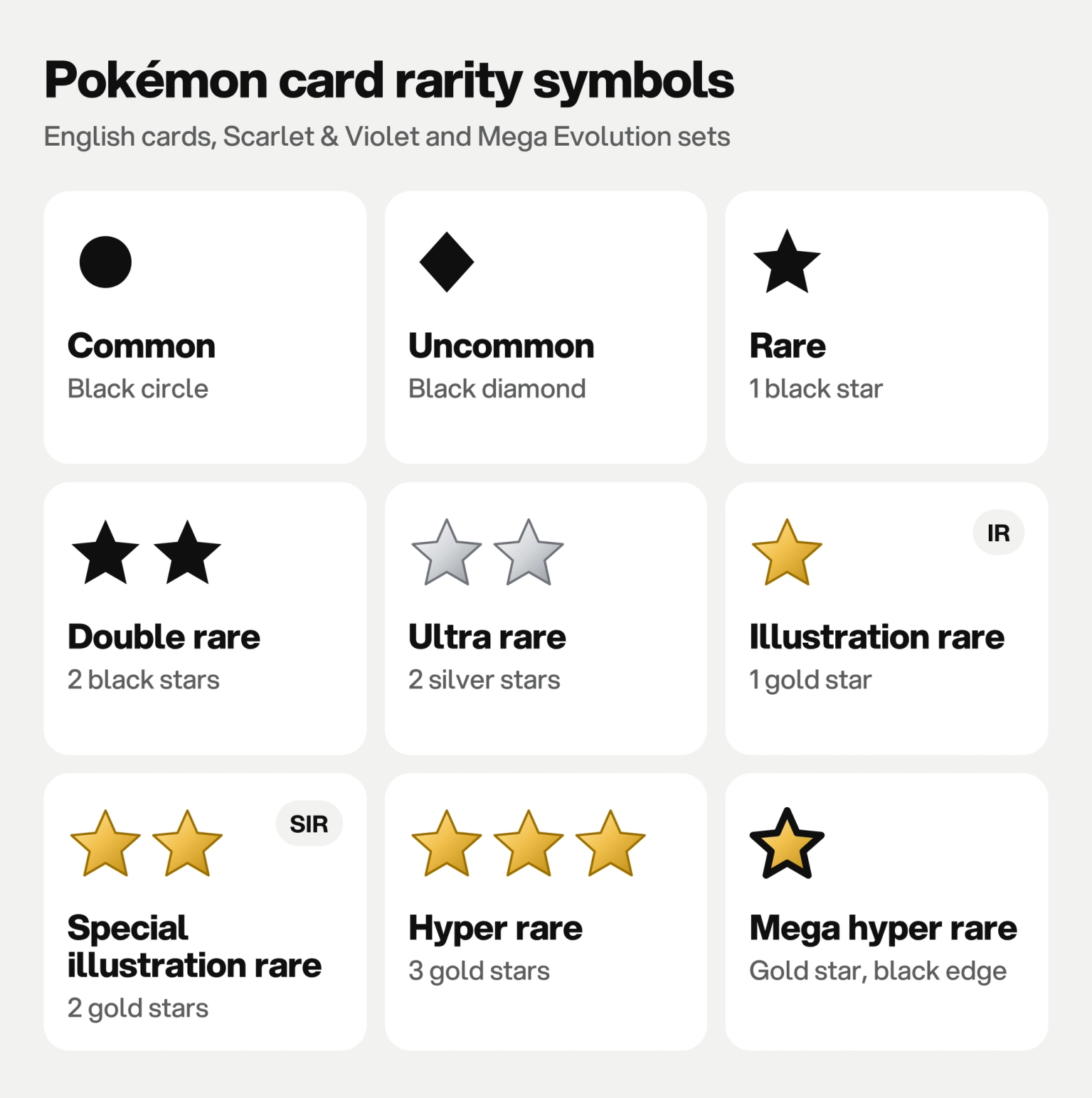
- Common, uncommon, rare: the basic rarities, shown by a small black symbol at the bottom of the card: a circle (common), a diamond (uncommon) and a star (rare).
- Double rare: two black stars. In Scarlet & Violet sets, this is where you find Pokémon ex.
- Ultra rare: two shiny silver stars. Full-art foil versions of Pokémon ex and some Supporter cards.
- Illustration rare (IR): one gold star. Alternate-art versions of regular Pokémon with full-art foil illustrations, often showing the Pokémon in its environment.
- Special illustration rare (SIR): two gold stars. Alternate-art full-art cards of Pokémon ex or Supporters.
- Hyper rare: three gold stars. Full-art foil cards with gold borders and accents. Collectors often still call these secret rares.
- Mega Hyper Rare: the last-numbered card in some Mega Evolution sets, such as Mega Rayquaza ex (141/103) in Delta Reign.
- Secret rare: any card numbered above the set's official count, such as 201/198.
- ACE SPEC: a powerful Trainer card. You can only have one ACE SPEC card in your deck.
- Shiny rare / shiny ultra rare: shiny-coloured Pokémon from special sets.
- Holo (holofoil): a card whose artwork has a shiny foil finish.
- Reverse holo (parallel foil): a card where the foil is on everything except the artwork.
- Full art: the artwork covers the whole card rather than sitting in a frame.
- Alt art (alternate art): a second version of a card with different artwork. Collectors use the term loosely for illustration rares and special illustration rares.
- Promo: a card released outside normal booster packs, for example in collections, events or ETBs. Marked with a promo stamp and number.
- 1st Edition: early Wizards of the Coast English print runs, marked with a "1st Edition" stamp. They can sell for more than later "Unlimited" prints.
- Shadowless: an early Base Set print without the drop shadow along the right of the artwork box. Often sells for more than later Base Set prints.
- ex, EX, GX, V, VMAX, VSTAR: special Pokémon card types from different eras, each with more HP and stronger attacks. When Knocked Out, they usually give up more Prize cards (two for a Pokémon-EX or Pokémon-GX).
- Tera Pokémon ex: Scarlet & Violet ex cards with a Tera type, shown by a crystal effect on the card.
- Error card / misprint: a card with a printing mistake. Some are collected; many sell for little more than normal.
- Set symbol and card number: the small set icon and number (such as 199/165) at the bottom of the card. Use both to look a card up.
Products
- Booster pack: a sealed pack of random cards. English packs contain 10 game cards plus an Energy and a code card.
- Booster box (booster display): a sealed box of booster packs, usually 36 packs for English main sets.
- Elite Trainer Box (ETB): a collector box with booster packs and accessories. The standard Delta Reign ETB contains 9 booster packs, 65 card sleeves, 40 Energy cards, a promo card, dice and a storage box. Pokémon Center exclusive ETBs contain more packs: 11 for Delta Reign.
- Tins, collection boxes and blisters: other sealed products with a few packs plus a promo card or pin.
- UPC (Ultra-Premium Collection): a large premium box with many packs, metal or special promo cards and accessories.
- Code card: a card with a code to unlock content in Pokémon TCG Live.
- Pack fresh: a card put straight into a sleeve after opening, never played with.
- RRP: recommended retail price, the price the manufacturer suggests shops charge.
- Booster bundle: a small pack of booster packs (6 for Delta Reign) without the extras of an ETB.
- Sealed: any unopened product. "Sealed collectors" keep it unopened.
- Singles: individual cards sold one at a time, rather than packs.
- Bulk: large numbers of low-value commons and uncommons, usually sold by the hundred or by weight.
- Repack: a pack made by a seller from cards that were already opened. Not an official product. See what are Pokémon repacks?

Condition and grading
- Raw: a card that hasn't been graded.
- Mint / near mint (NM): condition terms for raw cards. Near mint means almost no visible wear; definitions vary by seller, so ask for photos.
- Whitening: white specks on the edges or corners of the back of a card, from wear or factory cutting.
- Centring: how even the borders are. Off-centre cards grade lower.
- Grading: sending a card to a company that checks it's genuine, scores its condition and seals it. See how to get Pokémon cards graded in the UK.
- Slab: the sealed plastic case a graded card comes back in.
- Cert number: the unique number on a slab's label. Look it up on the grader's website to check it's real.
- PSA 10 / Gem Mint: PSA's top grade, for a virtually perfect card. PSA 9 is Mint. Other graders use their own top grades, such as CGC Pristine 10.
- PSA, CGC, BGS, ACE, TAG: grading companies you'll commonly see in UK listings: Professional Sports Authenticator, Certified Guaranty Company, Beckett Grading Services, ACE Grading and TAG Grading.
- Subgrades: separate scores for centring, corners, edges and surface. Some graders, such as Beckett, print them on the label.
- Pop report (population report): a grader's public count of how many copies of a card it has graded at each grade. Collectors use "pop" to judge how scarce a grade is. There's no fixed number for a "high pop": compare a card's top-grade count with similar cards from the same set.
- Crack: to break a card out of its slab, usually to resubmit it.
- Crossover: resubmitting a card still in one grader's slab to another grader. CGC, for example, crosses over PSA, Beckett and SGC slabs.
Buying, selling and opening
- Chase card: the most sought-after card in a set.
- Hit: a card above regular rare from a pack, such as an ex, an illustration rare or better.
- Pull: a card you get from opening a pack ("I pulled the SIR").
- Pull rates: how often a type of card appears in packs. The Pokémon Company doesn't publish them; figures you see online are usually fan estimates from opening many packs.
- Comps: recent sold prices for the same card and condition, used to price a card.
- Market price: what a card is actually selling for now, based on sold listings, not asking prices.
- Break: a live opening where buyers each pay for a defined share of a sealed product, such as a slot or a set of cards, and receive the cards for that share. How shares are allocated depends on the seller's listed rules. See how card breaks work.
- Live shopping / live auction: buying cards from a seller who's streaming live, bidding in real time. Tilt is a live-shopping marketplace for trading cards.
- LGS: local game store: a shop that sells cards and runs in-store play.
- Card show: an event with many sellers' tables in one hall.
- Buylist: the prices a shop will pay for cards you sell to them.
Storage
- Penny sleeve: a thin, soft plastic sleeve; the first layer of protection.
- Toploader: a rigid plastic holder for one sleeved card.
- Semi-rigid (card saver): a semi-flexible holder. Graders such as PSA ask for submitted cards in semi-rigid holders.
- Magnetic holder (one-touch): a hard two-part case that closes with magnets, for displaying valuable raw cards.
- Binder: an album with pocket pages. Use side-loading pages and avoid ring binders that press dents into cards.
Playing the game
- Standard format: the main tournament format, using only recent cards. Older cards rotate out, usually once a year. From 10 April 2026, cards with the G regulation mark rotated out, and H, I and J cards are legal.
- Rotation: when older cards stop being legal in Standard, based on the regulation mark.
- Regulation mark: the letter at the bottom of a card that shows which Standard rotation it belongs to.
- Expanded format: a format allowing cards from the Black & White Series onwards.
- Meta: the decks that are most popular and successful at the moment.
- Prize cards: the six cards set aside at the start of a game; take them all to win.
- Play! Pokémon: The Pokémon Company's official events programme, with leagues, tournaments and Championship Points.
See it live on Tilt
On Tilt, sellers stream live and you bid in live auctions, with buyer protection. Watch packs opened on camera, check a card's condition before you bid, and join breaks for the sets you collect.
FAQs
What do the rarity symbols on Pokémon cards mean?
The small symbol at the bottom shows rarity: circle for common, diamond for uncommon, star for rare. Scarlet & Violet and Mega Evolution sets use black, silver and gold stars for double rares, ultra rares, illustration rares, special illustration rares and hyper rares.
What does SIR mean in Pokémon?
Special illustration rare: an alternate-art, full-art card of a Pokémon ex or Supporter, marked with two gold stars.
What is an ETB in Pokémon?
An Elite Trainer Box: a collector box with booster packs, sleeves, Energy cards, dice and a promo. A standard ETB, such as Delta Reign's, contains 9 booster packs.
What does raw mean in Pokémon cards?
A raw card is one that hasn't been graded or put in a slab.
What is a pop report?
A grader's count of how many copies of a card it has graded at each grade.